“How much does influencer marketing cost India?” is the first question almost every brand asks — and the most common answer, “it depends,” is useless when you are trying to plan a budget.
So this guide gives you the real numbers. Below you will find 2026 rate cards by creator tier, the difference between Instagram and YouTube pricing, the niche and add-on factors that move rates, the agency and platform fees most guides leave out, and a simple framework for setting your monthly budget.
A quick note before the tables: these are benchmark ranges, not fixed prices. Two creators with identical follower counts can quote very different rates because niche, engagement, content quality, audience trust, and usage rights all change the final number.
Influencer rate card India 2026 (by tier)
Creators are usually grouped into tiers by follower count. Here are typical per-deliverable ranges for Instagram in 2026.
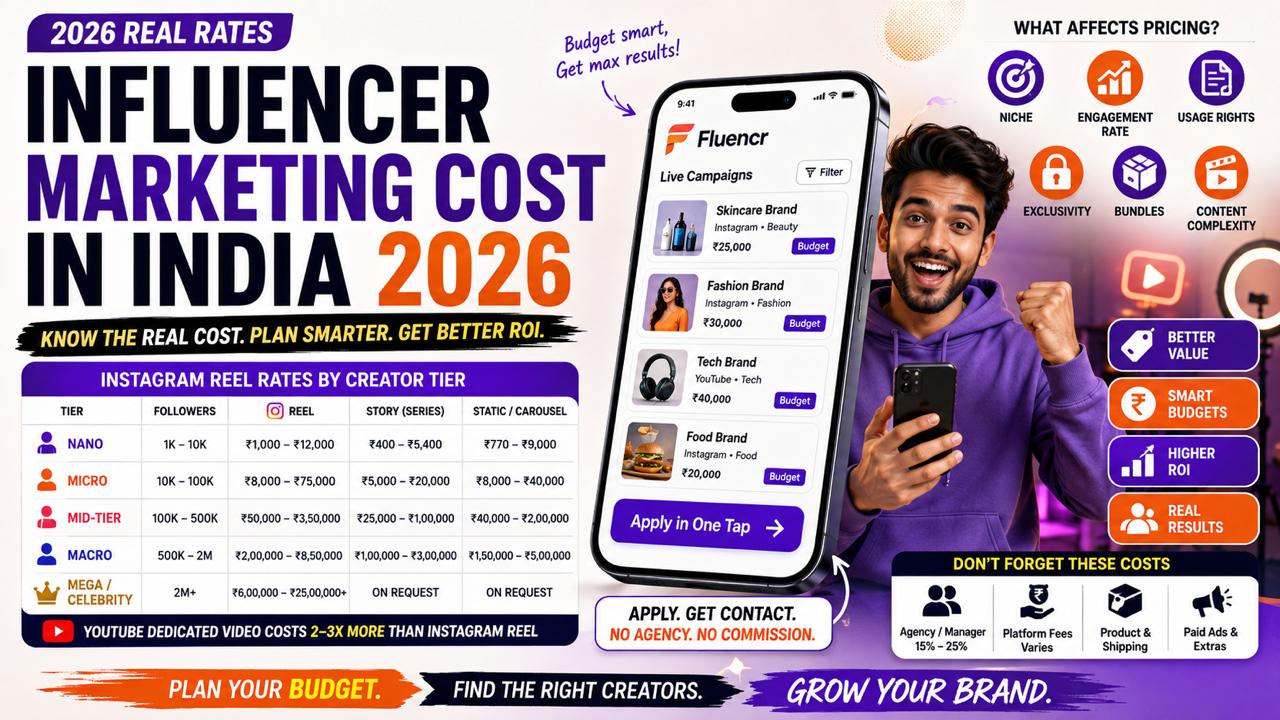
| Tier | Followers | Instagram Reel | Story (series) | Static / Carousel |
|---|---|---|---|---|
| Nano | 1K–10K | ₹1,000 – ₹12,000 | ₹400 – ₹5,400 | ₹770 – ₹9,000 |
| Micro | 10K–100K | ₹8,000 – ₹75,000 | ₹5,000 – ₹20,000 | ₹8,000 – ₹40,000 |
| Mid-tier | 100K–500K | ₹50,000 – ₹3,50,000 | ₹25,000 – ₹1,00,000 | ₹40,000 – ₹2,00,000 |
| Macro | 500K–2M | ₹2,00,000 – ₹8,50,000 | ₹1,00,000 – ₹3,00,000 | ₹1,50,000 – ₹5,00,000 |
| Mega / Celebrity | 2M+ | ₹6,00,000 – ₹25,00,000+ | On request | On request |
The biggest jump in value-for-money sits in the nano and micro tiers. They cost the least, engage the most, and feel the most authentic to local audiences — which is why most small and mid-sized D2C brands build their programs here.
Instagram vs YouTube: why YouTube costs more
A dedicated YouTube video typically costs 2–3x the equivalent Instagram deliverable. For a micro creator, a dedicated YouTube video commonly runs ₹20,000–₹1,20,000.
The reasons are simple: YouTube content takes far more time to produce, it lives and keeps earning views for months or years (Instagram Reels peak in days), and viewer intent is higher — people search YouTube to research purchases. If your product needs explanation (tech, finance, education, appliances), YouTube often delivers better long-term ROI despite the higher upfront cost.
What moves the price up or down
Follower count is only the starting point. These factors swing rates significantly:
- Niche. Finance, tech, health, and B2B command 30–50% higher rates than lifestyle, food, or general entertainment, because their audiences are harder to reach and worth more.
- Engagement rate. A 10K creator with 8% engagement can out-earn a 50K creator with 1%.
- Usage / whitelisting rights. Want to run the creator’s content as a paid ad from your own or their handle? Expect to pay 20–100% extra.
- Exclusivity. Asking a creator not to work with competitors for a period costs more.
- Bundles. Multi-deliverable packages (e.g., 1 Reel + 3 Stories) usually come at a per-unit discount.
- Production complexity. Scripted concepts, special locations, or props raise the rate.
The fees most guides don’t mention
The creator’s quote is rarely your total cost. Budget for these too.
Agency and manager commissions. Macro and celebrity creators usually work through managers or talent agencies that add 15–25% commission on top of the quoted rate. Full-service agencies that handle strategy, discovery, and reporting charge a retainer or a percentage of spend.
Platform fees. Influencer marketing platforms charge in different ways — subscriptions, per-campaign fees, or a commission on creator payouts. This is worth comparing closely, because it directly affects how far your budget goes.
Product and shipping costs for barter or seeding campaigns.
Content production extras — paid ad spend to amplify the best content, plus any editing or rights fees.
On Fluencr, brands connect with creators directly and exchange contact details the moment a creator applies — so there is no middleman taking a cut of the conversation. You negotiate rates straight with the creator.
How much should your brand budget per month?
A useful 2026 rule of thumb for D2C and mid-sized brands running a serious influencer program: most spend ₹3–25 lakh per month.
- Below ₹2 lakh/month, the discovery and management overhead tends to eat most of the budget — unless you keep it lean by working with nano/micro creators you find yourself on a self-serve platform.
- Above ₹25 lakh/month, returns start compressing unless you move into macro creators or run multi-platform, always-on campaigns.
A practical starting structure for a brand new to influencer marketing:
- Test phase (Month 1–2): ₹50,000–₹1,50,000. Work with 5–10 nano/micro creators on small, measurable deliverables.
- Double down (Month 3–4): Reinvest in the 2–3 creators and content formats that performed, and amplify winning content with paid ads.
- Scale (Month 5+): Add mid-tier creators and longer-term ambassador deals once you know your cost per result.
Always test multiple creators in small campaigns before scaling spend behind any one of them.
A simple way to estimate ROI
Before you sign anything, estimate the math:
- Cost per deliverable (the creator’s rate)
- Expected reach (followers × typical view rate)
- Expected actions (clicks, code uses, sign-ups) based on the creator’s past results
- Cost per result = total cost ÷ expected actions
Ask creators for anonymized results from past brand work. Creators who can show they drove clicks or conversions are usually worth their higher fee — and the ones who cannot should be priced accordingly.
How to keep costs down without killing results
- Lean into nano and micro creators — best engagement per rupee.
- Negotiate bundles instead of one-off posts.
- Reuse the best content as paid ads to extend its life cheaply.
- Find creators directly on a self-serve platform to avoid agency markups.
- Prioritise fit over fame — a perfectly matched 20K creator beats a generic 500K one for most products.
Frequently asked questions
How much does influencer marketing cost in India in 2026?
For most brands it ranges from a few thousand rupees per nano-creator post to several lakh for macro creators. A typical serious monthly program runs ₹3–25 lakh, but you can start meaningfully with ₹50,000–₹1,50,000 using nano and micro creators.
Are micro-influencers cheaper than macro-influencers?
Yes — significantly. Micro creators (10K–100K) charge roughly ₹8,000–₹75,000 per Reel versus ₹2 lakh+ for macro creators, and they usually deliver higher engagement, making them the best value for most brands.
Why is YouTube influencer marketing more expensive?
A dedicated YouTube video costs 2–3x an Instagram post because it takes more effort to produce, keeps earning views for months, and reaches higher-intent viewers.
Do I have to pay agency fees?
Only if you use an agency or work with creators who have managers (typically 15–25% commission). You can avoid these by finding and contacting creators directly through a self-serve platform like Fluencr.
What’s the cheapest way to start?
Run a small test with nano/micro creators you find directly, focus on one platform, and amplify the best-performing content with a little paid ad spend.
Plan your budget, then find the right creators
Influencer marketing in India is flexible enough to work at almost any budget — the key is matching the creator tier to your goal and avoiding unnecessary middleman costs.
Once you know your budget, the next step is finding creators who fit. On Fluencr, you can post a campaign with your budget and goals, receive applications from verified creators across India, and negotiate rates with them directly. Post your first campaign and see who applies.
Rate ranges are 2026 market benchmarks compiled from public Indian rate-card data and may vary by creator, niche, and deliverable.